Monthly Imapp Data Upload as Well as Analyzing Financial Variances
When it comes to financial modeling, comparing and analyzing your budget vs actuals is extremely important.
Y'all might retrieve you know how much revenue you lot'll generate, or what your expenses volition be over the adjacent few months. Merely as whatever founder volition tell you, things don't always get equally planned.
In this commodity, we're going to break downward the deviation betwixt your upkeep and actuals, how to analyze both, and what to do when your upkeep and actuals don't line upwardly.
Table of contents
- What is the divergence between your budget vs actuals?
- Why do both your budget and actuals affair?
- How practice you clarify budget vs actuals?
- What do y'all do when your upkeep and actuals are different?
What is the Deviation Between Your Upkeep vs Actuals?
A upkeep represents the financial metrics that your company is expected to hit throughout the year. These numbers include revenue, expenses, cash flow, cash runway, and whatsoever other metrics you're tracking with your financial model.
Retrieve of your upkeep every bit the target numbers yous expect your startup to hit.
On the other mitt, actuals are the real numbers your company has actually striking. They're not what you lot're forecasting to hit, or what you're aiming to hit—they're the reality.
In short, your budget represents the numbers your startup expects to hit, while actuals are the numbers you lot've achieved in reality.
When combined with your financial forecast, this is what each represents:
- Upkeep: What your startup expects to attain
- Actuals: What your startup actually achieved
- Forecast: What your startup is projected to achieve in the hereafter based on by data
This means that, unlike a budget or forecast, you cannot plan your actuals before they happen. You tin can merely analyze them in one case you have the data of a completed fourth dimension period.
Why Budget and Actuals Both Thing
When you accept a budget, you know where your startup wants to go. Every bit a result, you tin take the necessary steps to attempt to hit those numbers.
For case, if you lot've approaching a cash runway of $500,000 earlier the end of the twelvemonth, but your current cash rails is only at $300,000, you know that you'll need to:
- Lower your burn rate to extend your runway
- Reduce client churn past improving the customer experience and making sure your activation rate increases
- Increase monthly acquirement New Monthly Recurring Acquirement (past increasing the number of customers y'all learn each calendar month
- Reduce your customer conquering toll (CAC)
- Improve your current conversion rate from website visitors to leads, and leads to paying customers
When it's fourth dimension to compare your budget with your actuals, you'll be able to see what worked and what didn't. You'll have a reason for both your failures and your wins.
Based on what went right or wrong, you lot can take the appropriate steps to fix the issue going forward and optimize what'due south working.
How Exercise Y'all Analyze Upkeep vs Actuals?
Comparing your budget and actuals is called a budget to actual variance analysis. Non only will y'all have a look at how your numbers vary, but you'll too try to understand the reasons behind this variance.
Yous tin take two types of variances:
- A favorable variance ways that your actuals are better than your budget numbers
- A negative variance means that your actuals are worse than your budget numbers
Keep in mind that 'favorable' doesn't necessarily hateful 'lower', and 'negative' doesn't necessarily mean 'higher'.
For case, a higher CAC isn't a favorable effect for your business organisation. If your budget specified a CAC of $500 or nether, a CAC of $one,333 is a problem.
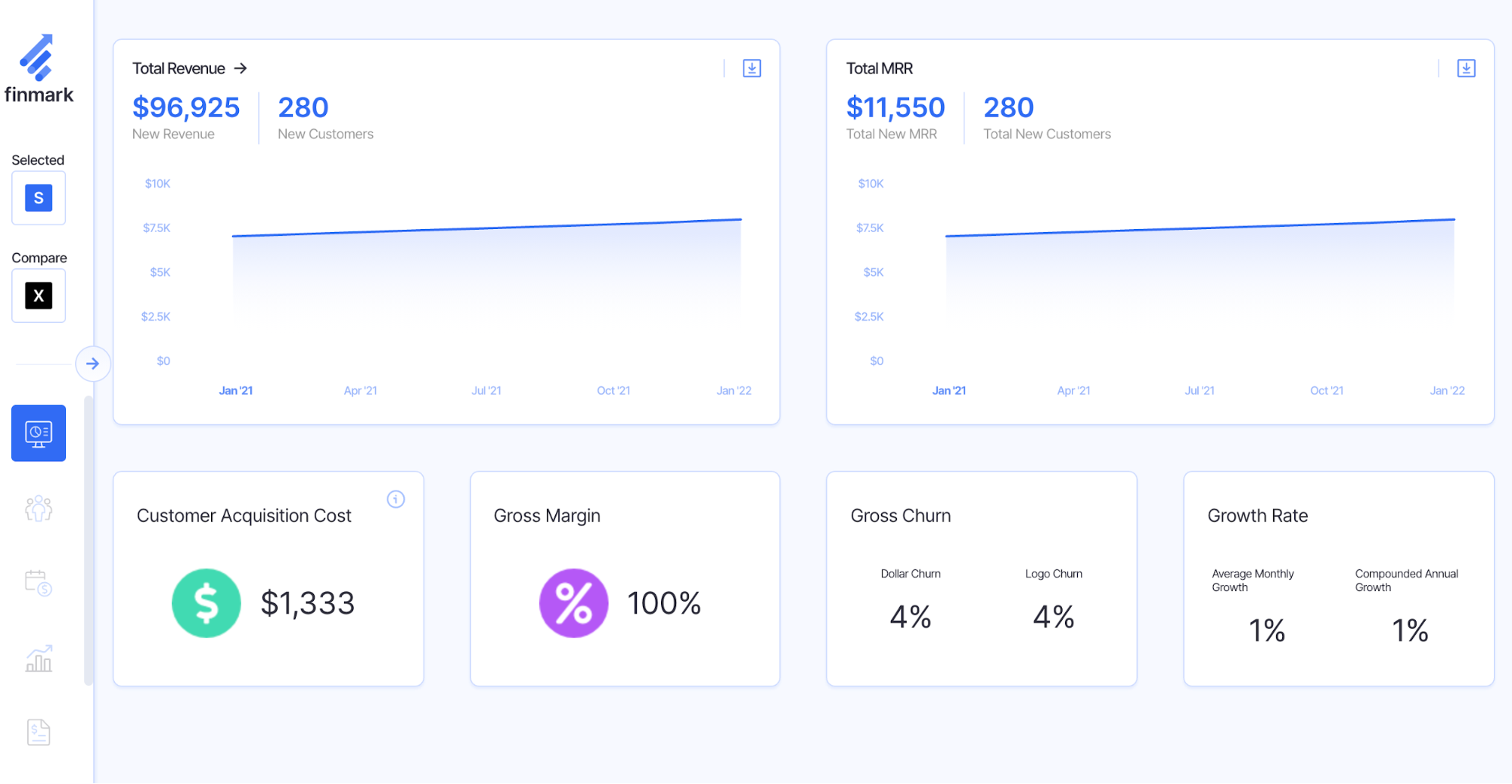
This is why it's better to use the terms 'favorable' and 'negative' when discussing the variances you lot find instead of 'higher' and 'lower'.
Traditionally, startups have been forced to employ spreadsheets to clarify and compare budget vs actuals. Still, spreadsheets and pre-made templates tin hands go complicated and difficult to manage, especially when you take several people working on the aforementioned document. Finmark makes it easier to compare your budget and actuals and share it with your team, investors, or other stakeholders.
How to Analyze Budget vs Actual Variance
Once you lot've analyzed your upkeep and actuals, you'll know what your variance looks like for each metric.
While it's normal to accept a piddling bit of variance for each budgeted number, getting a negative variance is a sign that something needs to change.
So what can you lot exercise if you get a negative variance? For example what if your actual revenue throughout the year ends upward lower than your budgeted revenue?
1. Discover The Source of The Negative Variance
Startups have several moving pieces, then a negative variance between your budget and actuals may non always come from the same source.
Let's say your actual expenses are college than what was budgeted. While looking at the full expenses will tell you how large this variance is, you'll need to swoop into each expense category to see where this comes from:
- Is your CAC higher than expected?
- Are your conversion rates for paid ads depression, which would result in a higher ad spend?
- How expensive is your customer service compared to previous years or what was planned?
- What other expenses are higher than originally planned?
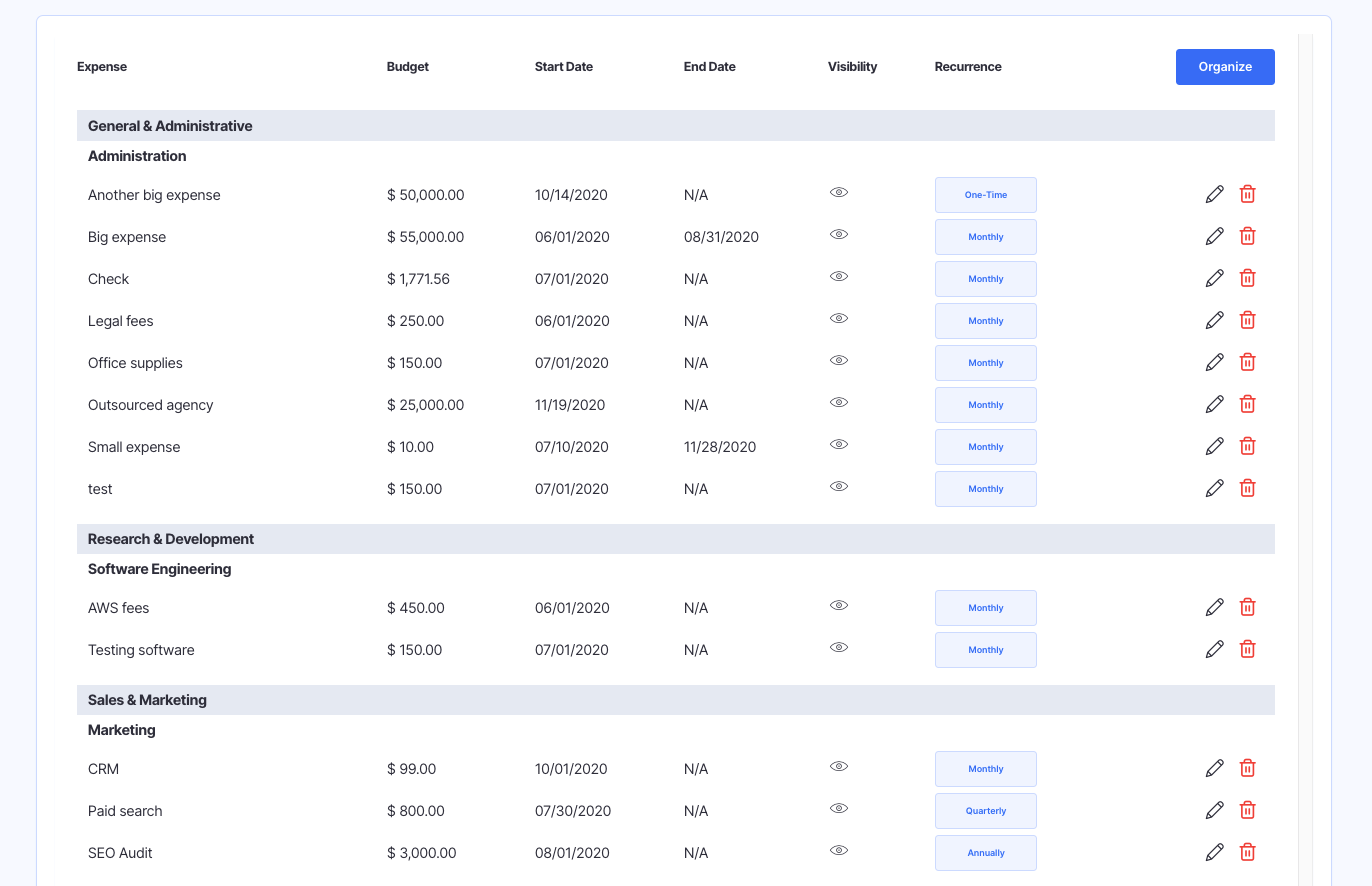
On the other manus, if your greenbacks runway is significantly shorter than expected, yous could take a await at the post-obit:
- What does your fire rate look similar, and why?
- Has customer churn increased while New MRR has decreased?
- Have you started spending too much on an advertising campaign that isn't yielding returns?
Go along in mind, variance is normal. If your upkeep and actuals line up 100%, you should probably play the lottery because luck is on your side.
However, when the variance is farthermost, start digging into the "why" behind it.
2. Analyze What Happened at The Source
At present that y'all've plant one or several reasons why the variance exists, it's time to dive deeper into the reasons why this occurred.
For example, if you realized that your expenses are college because your customer service is costing y'all more what was originally planned, information technology could be caused by several factors:
- A lack of established processes for customer service reps to stay productive and help customers more efficiently
- Not enough resources (blog posts, video guides, documentation, etc) for customers to troubleshoot issues on their own
- Also many client service reps for too few bug
Depending on the result, you'll have dissimilar courses of action yous can take.
3. Brand a Programme to Prepare The Variance
Once you sympathize where the variance came from and what happened to cause the issue, y'all'll have the data yous need to create a plan of activeness.
If nosotros take the previous example of client service, let's say the consequence was a lack of educational resources for customers to use.
So what tin can you do to fix this?
One way would be to invest in creating more in-depth documentation for your customers to self-service when they have production questions.
The more than contained your customers become, the less likely they are to get stuck and rely on your customer service team—or end up churning.
Here's some other case. Permit's say yous've found out your visitor is spending besides much on financial assay. Your team is spending too much time managing spreadsheets and computing formulas. This time could exist better used on revenue-generating tasks.
To help reduce your bodily expenses to fit your budget, y'all could detect tools to streamline the process so that less time is spent on these tasks.
4. Go along Improving Your Forecasting Skills
At start, creating a budget for your startup will be difficult, especially if you don't have much data to piece of work from.
Merely equally you compare your budget and your actuals more than often, you'll get better at accurately forecasting your metrics, which means you can plan a more realistic budget.
Every fourth dimension y'all create a new budget, go on the past variances in mind and look for opportunities to plan more than accurately based on what you know now. (hint: Finmark can help with that)
Stay on Top of Your Upkeep vs Actuals to Move Towards a Profitable Startup
Turning a startup into a profitable business doesn't happen by accident. In lodge to get in happen, it'south crucial to keep rail of non just your actual numbers, but how these numbers compare to your budget so that you tin program more efficiently in the futurity.
Finmark makes it easy to compare your budget and actuals, all without complicated spreadsheets. See it for yourself past signing up for a free demo!
Source: https://finmark.com/budget-vs-actual/

Post a Comment for "Monthly Imapp Data Upload as Well as Analyzing Financial Variances"