Is There a Underground Market for Beef in India
Bangalore, India – "Modi ko matdan, gai ko jeevadan [Vote for Modi, give life to the cow], BJP ka sandesh, bachegi gai, bachega desh [BJP'southward message, the cow will exist saved, the country will exist saved]."
Mayankeshwar Singh, National Convener of the Moo-cow Development Cell of India'due south main opposition political party, the Bharatiya Janata Party (BJP), spells out a few slogans used in the electric current parliamentary elections.
"The start one was widely distributed via text messages," he told Al Jazeera.
The Hindu god Lord Krishna'south favourite brute and the divine bovine, Kamadhenu or "Mother Cow" is revered equally sacred by Hindus who constitute most 80 percent of the land's population.
It is this sanctity that the Hindu nationalist political party has vowed to uphold if it comes to power.
Singh said that the conservation, protection and promotion of the moo-cow is a elevation priority for the political party. It figures in the political party's manifesto released on Apr seven alongside other controversial plans such as building of the contentious Ram Temple in Ayodhya and cleanup of the Ganges – considered holy past Hindus.
Cow protection is likewise 1 of the key weather laid downwardly by Hindu right-wing organisations such as Rashtriya Swayamsevak Sangh (RSS) and Vishwa Hindu Parishad (VHP) to back BJP's Narendra Modi every bit their prime number ministerial candidate.
Singh'due south belief that "cow murder is a national criminal offense" resounds within religious fundamentalist Hindus that vehemently oppose moo-cow slaughter.
Mocking 'pink revolution'
Before this calendar month, Modi, the front-runner in the general elections, took a potshot at the ruling coalition (United Progressive Alliance) government for country'due south soaring beefiness exports.
We will build 'cow hostels' in cities, 'cow alimony' will go along farmers from selling old animals to slaughterhouses, a 'moo-cow protection force' will exist mobilised to rescue cows
The only revolution under the government had been the "pink revolution", he remarked.
He blamed that subsidies were given to slaughterhouses, simply not to those who tend cows, an allegation the Congress party rejected maxim he (Modi) was "communalising fauna husbandry".
The BJP'due south promises and plans for India'south cows are plenty.
"We volition build 'cow hostels' in cities, 'moo-cow pension' will continue farmers from selling old animals to slaughterhouses, a 'moo-cow protection force' will be mobilised to rescue cows," Singh told Al Jazeera.
"Our dream is to also build a 'cow academy' to teach the usefulness of the indigenous cow," he said.
Strict implementation of cow-related laws and a reverence for the beast is promoted in all the BJP-ruled states in the South Asian country of 1.two billion people.
In the western Gujarat state, of which Modi is main government minister since 2001, consumption of both beef and booze are banned, and moo-cow slaughter can result in a seven year jail term.
The neighbouring Rajasthan country has taken cow protection a stride further with its reported plans for India's outset "Ministry for Cows", while Madhya Pradesh state has set a cow sanctuary.
The BJP-led regime launched a plan to buy cow urine to be used for diverse medicinal purposes when information technology was in power in Himalayan state of Uttarakhand.
For many, the BJP's emphasis on the cow, an explicit symbol of Hindu piety, stokes differences betwixt Hindus and beef-eating minorities.
Poor human's diet
Not only Muslims and Christians, but as well Bharat's Scheduled tribes and Scheduled castes – who business relationship for 25 percent of the state's population, are beef eaters.
In the states of Kerala, West Bengal and most of the Northeastern region – where cattle slaughter is legal, beef is widely consumed.
"Beef is one of the nearly affordable sources of protein for the Dalit community," said Mohan Dharavath, President, Dalit Adivasi Bahujan and Minority Students' Clan based in southern city of Hyderabad.
The Association organised two controversial "beefiness festivals" in the city's universities, serving beefiness curry and beef biriyani – a pop rice and meat dish.
The motive was to assert ane's correct to cull own food. The events drew huge crowds, including professors and students beyond faiths and castes, said Dharavath.
The student-fly of the BJP came out openly against the use of beef in university canteens.
While universities are meant to be secular, "food politics" has seeped into canteens, Dharvath told Al Jazeera.
"Universities used to have split mess halls serving pork and beef in the 1970s, but they decline to exercise so at present. Brahamincal ideas of what food is acceptable is imposed on anybody," he said.
A book on the dietary traditions in ancient Republic of india was banned for a while because information technology claimed that Brahmins, who occupy the top rung of Hindu caste ladder, were one time beef eaters.
"It got me all kinds of threats," Professor Dwijendra Narayan Jha, a historian and writer of the book, the Myth of the Holy Cow, told Al Jazeera.
While Hindu religious fundamentalists have ever associated cow slaughter with Muslims, Jha in his volume pointed out that eating beef was common in Vedic and subsequent times among Brahmins long before the advent of Islam to Bharat.
"There is no doubt that beefiness remained an important part of the Indian haute cuisine and cow was often killed in honour of guests. It is totally groundless to argue that Hindus never ate the flesh of the moo-cow," he said.
Governments take also been instrumental in reinforcing these beliefs. For example, references to ancient Hindus eating beef were deleted from school text books in 2006. The process was gear up in movement under the previous BJP-led government.
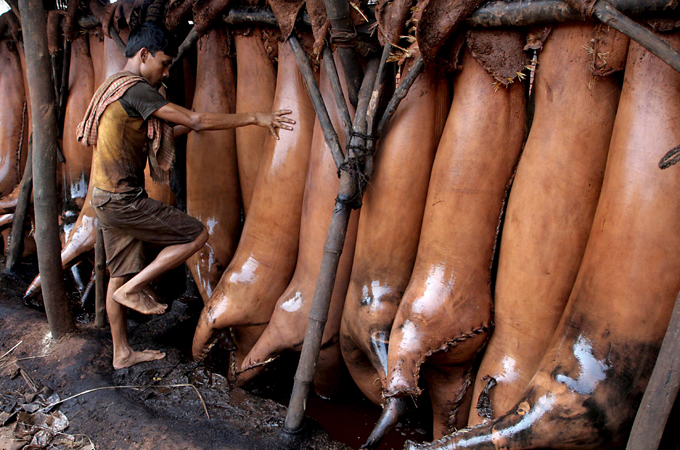 |
| An Indian labourer works on buffalo and cow leather in a tannery workshop in the Indian urban center of Kolkata[File: EPA] |
Beefiness export
Despite the sentimentality around beef, Bharat today is amid the earth's pinnacle beef exporters, 2d only to Brazil. Beef worth $29m was exported in the year 2012-xiii.
In the western Gujarat country, meat export has doubled in the last decade, according to a contempo report, and it ranks amid the country's superlative 10 states with slaughterhouses.
Much of the "beef" that political parties are grouse over and all the legal beef exported is, in fact, "carabeef", meat of the water buffalo and not the cow.
Though significant in Republic of india's agriculture, the blackness-skinned water buffalo, the vehicle of Yama – the Hindu god of decease – is not seen as holy.
Azhar Quershi, General Director, Mirha Exports, among India's top beefiness exporters, said there are many factors that had made the manufacture successful.
"Indian buffalo meat is a good quality yet affordable alternative in the international market. It is priced at almost half the price of beef from other markets," he said. "Republic of india besides has the earth's largest population of buffaloes."
The industry provides livelihood for a big number of people engaged in the supply chain of procuring cattle, processing, deboning, packing, and allied industries such as leather, pharma and pet food.
In India, the most of import cog in the wheel of the beef manufacture is the farmer, who supplies cattle to slaughterhouses.
Uneconomical animals such as anile milch cattle, bulls or male person calves are sold fetching at least a minimum of $332 (Rs 20,000). This is a vital source of income for farmers and a meaning security in dire times such as ingather failure or drought.
This is non about protecting cows, it is most playing politics
Bharat's 177 million Muslims in detail, who form a majority in the beefiness business, are targeted in the guise of cow protection and welfare, Rustum Shafiullah, the secretarial assistant of Beefiness Merchants Association of Karnataka, said.
His customs, the Qureshis, take been butchers for generations and that "any ban could economically destroy" them, he said.
The ban on cow slaughter has besides fuelled an underground business.
"Cows are often either illegally transported long distances to where slaughter is legal, such equally southern Kerala land and neighbouring country of Bangladesh. Or killed in illegal slaughterhouses. There are an estimated 30,000 illegal, unlicensed slaughterhouses in India," said Poorva Joshipura, CEO of the animal welfare group PETA's headquarters in Bharat.
Joshipura said that the leather usage is directly related to cattle slaughter, while cows involved in dairy production also undergo various cruelties.
Shafiullah who buys cattle from farmers' markets said: "Farmers can barely sustain themselves, nosotros cannot expect them to treat unproductive animals."
"Why practise non political parties buy the cows instead of us and ensure them a decent life?This is non about protecting cows, it is about playing politics," he said.
Source: https://www.aljazeera.com/features/2014/4/20/sacred-cows-and-politics-of-beef-in-india

Post a Comment for "Is There a Underground Market for Beef in India"